Bloomsbury Associates


Bloomsbury blog Why is everyone talking about bonds?
Bloomsbury blog post, 10 October 2026
Bonds don't get the same airtime as other asset classes - shares, property, derivatives, even crypto. But this year, bond market movements have been front-and-centre in financial markets commentary.
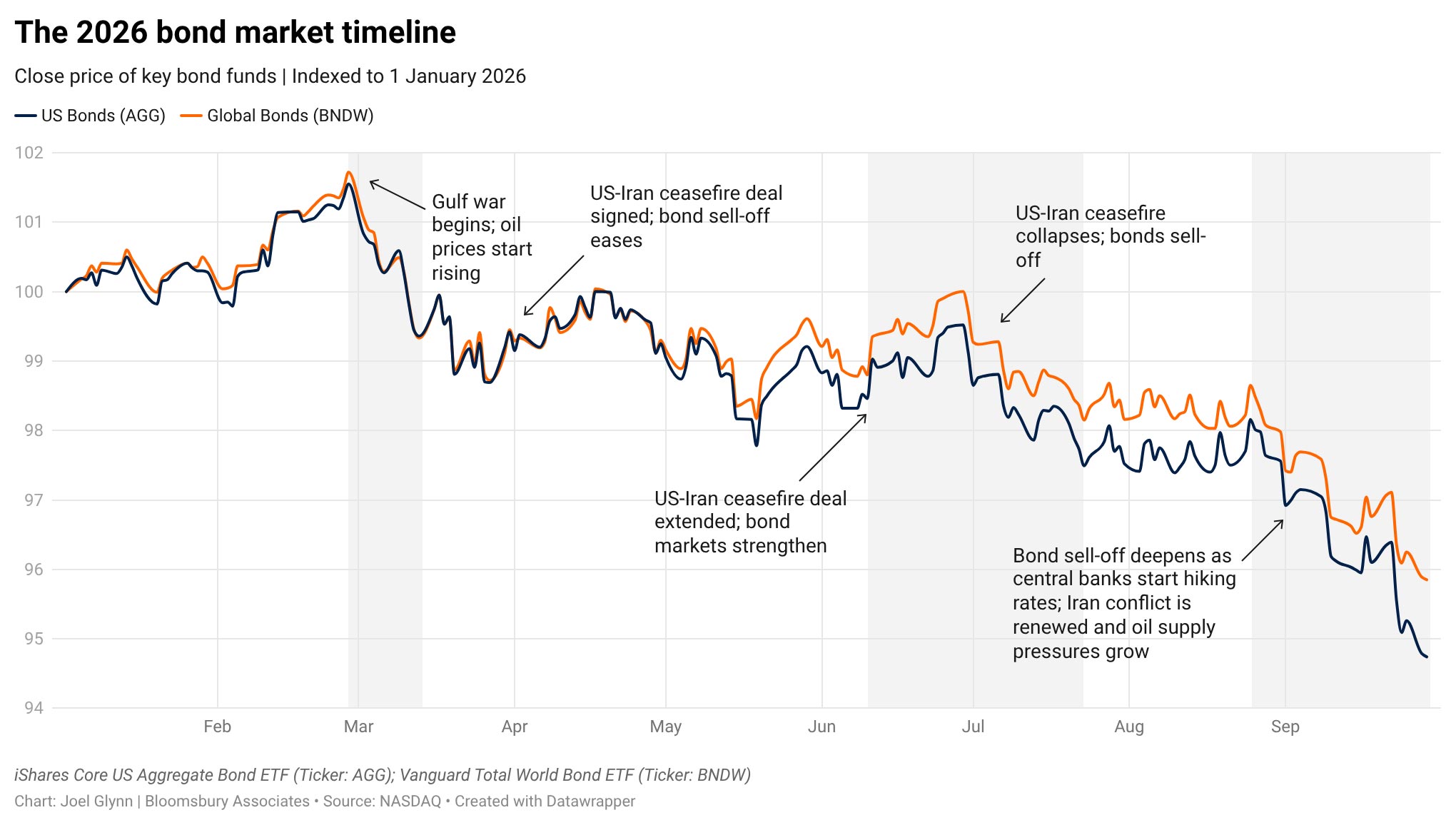
The US 10-year Treasury yield, a key indicator of global borrowing costs, sat at 5.3% at the end of September, its highest level since 2002. Higher yields have driven global bond prices down, with Vanguard's index-tracking Total World Bond fund down 4.15% year-to-date.
In this post, we explore what's driven the sell-off in bonds and what New Zealand investors should do going forward. The chart below summarises key events and bond market movements in 2026. We explore these events in more detail below.
The 2026 bond market timeline
See larger version of this image
What makes bond markets move
A bond's yield is the market's implied return if you buy it at today's price and hold it to maturity. The bond yield for newly issued bonds is affected by central bank interest rates, expectations about future rates, inflation expectations, economic growth, and government debt.
In short, when borrowing costs increase, bond yields rise too. When bond yields rise, the price of existing bonds falls, as the newer bonds have more attractive implied returns.
Critically, yields don't represent today's actual interest rates, but today's expectation of tomorrow's interest rates. It is the change in expectations of the future that affects yields (prices) now.
War in the Middle East
This year's first sell-off in the bond market started following reports of fresh military conflict in the Middle East. US-Israeli air strikes on Iran killed the country's Supreme Leader on the 28th of February. Iran retaliated soon after, targeting Israel and neighbouring Gulf states.
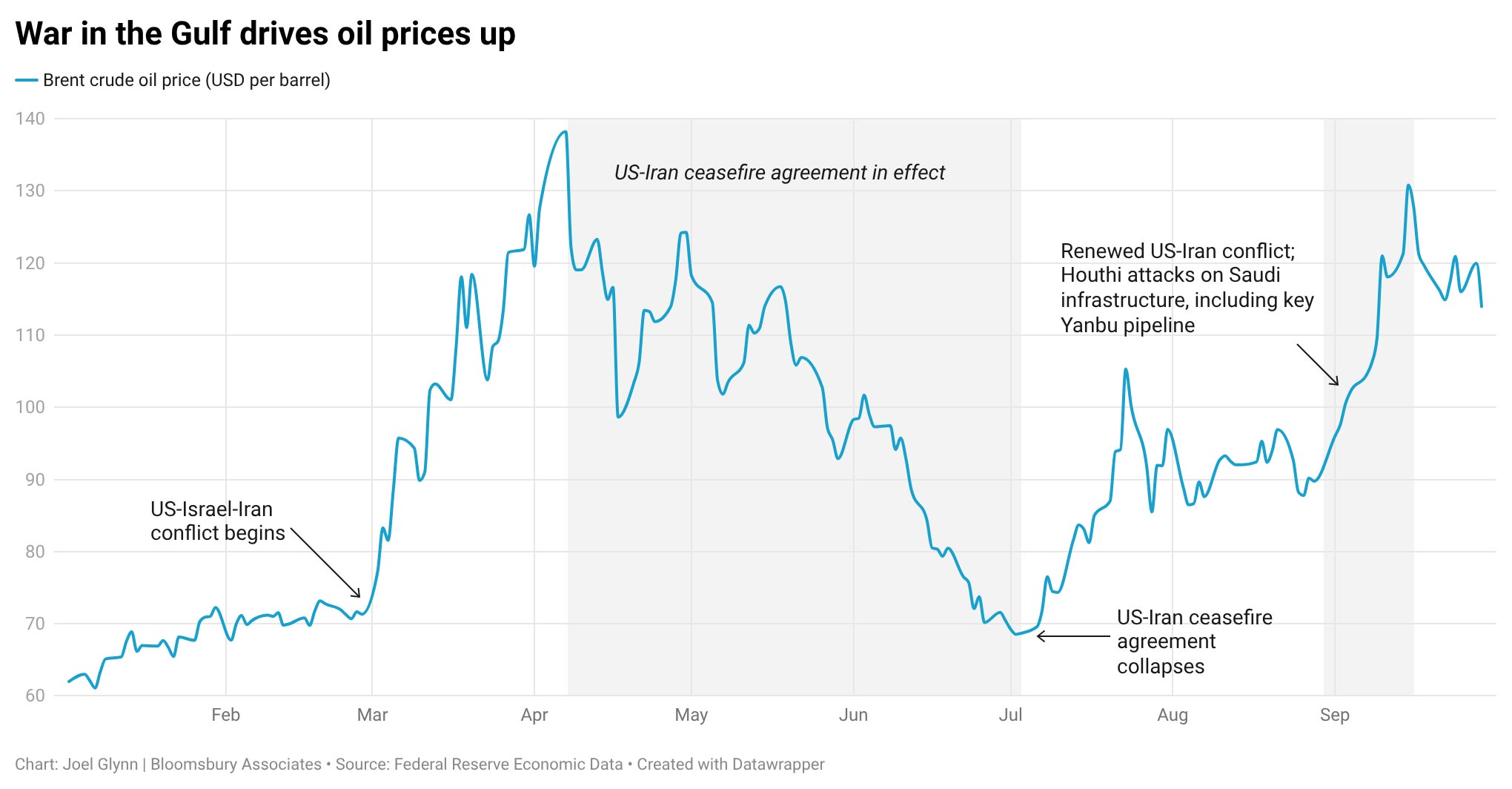
Iran went on to effectively close the Strait of Hormuz, tightening global oil supply, driving the price of Brent crude from just over $70 USD per barrel in late February to $120 USD by late March. Official data reported strong inflationary pressure in the US, with similar fears in other countries.
Market expectations of higher inflation, rising oil prices, and higher borrowing costs lifted bond yields, driving bond prices down.
Iran deal collapses
A ceasefire deal signed between the US and Iran in April was extended in mid-June, easing global oil prices with Brent crude prices falling back to around $70 USD per barrel by the end of June.
However, on the 8th of July the ceasefire deal collapsed. Over the following weeks, the price of oil again reached $100 USD per barrel. Once more, bond yields rose, bond prices fell.
Bond market woes deepen in September
In September, central banks began hiking key interest rates. On the 2nd of September, the Reserve Bank of New Zealand lifted the Official Cash Rate by 25 basis points to 2.75%. This was the second 25 basis point raise this year, with the bank already tightening monetary conditions with a 25 basis point hike in July.
The US 10-year Treasury yield surpassed 5% in mid-September and on the 16th the US Federal Reserve hiked the federal funds rate by 25 basis points to 3.75%-4.00%. This was the first US interest rate hike since July 2023.
Military conflict in the Gulf was renewed and Houthi attacks on Saudi energy infrastructure caused further disruptions to global oil supplies. Oil prices stayed high, with Brent crude sitting between $100 and $130 USD per barrel over the month of September. The chart below highlights the effect of the war in the Gulf on oil prices this year so far.
War in the Gulf drives oil prices up
See larger version of this image
These factors combined to continue and deepen the bond market sell-off in September, as higher interest rates, high oil prices, and more inflationary pressure increased borrowing costs, which lifted bond yields and continued to drive down bond prices.
What this means for NZ investors
Despite not being discussed as much as growth assets like property and shares, bonds are a core feature of most well-balanced, diversified investment portfolios. The question for New Zealand bond investors is what this year's bond market movements mean for them and their investment portfolios.
Bond market sell-offs are not all bad. Bond market sell-offs are uncomfortable for bond investors because it shows up as lower priced bonds on their reports. But it's not all bad news. Higher yields mean new and reinvested funds are expected to earn more than before. The pain on existing holdings is necessary for the better income on offer for new holdings.
Bond markets can't be consistently timed. By the time a headline hits: "Ceasefire over"; "Fed hikes rates"; "Oil prices back above $100" - the news is already priced in. Bond markets trade on expectations. Waiting for certainty usually means buying after the price change has happened. We cannot reliably pick the day oil peaks, a peace deal is signed, or how a country's monetary policy will change.
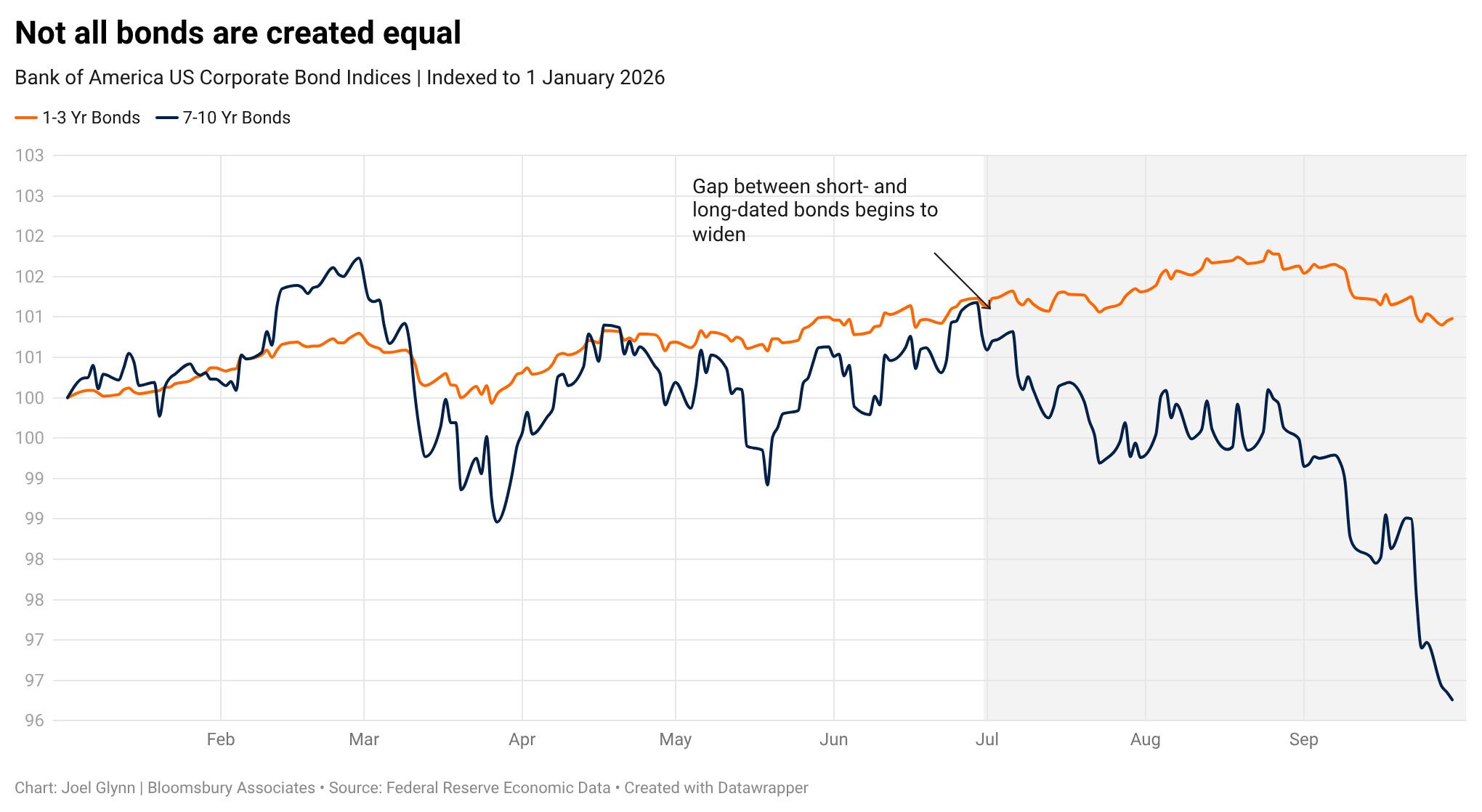
Different bonds have different levels of risks. Bond returns are primarily driven by term and credit risk. Credit risk is the risk that the issuer of the debt (say a government or a company) defaults on the debt. Term risk is the length of the debt payback period. Assuming credit risk is equal, longer term debt at fixed interest rates is more risky, leading to higher expected returns, though with more volatility. The chart below highlights how higher term risk has led to larger decline in longer-term bond returns compared to shorter-term bonds.
Not all bonds are created equal
See larger version of this image
These US Corporate bond indices show short-dated bonds generating a positive return of around 1.0% year-to-date, while longer-dated bonds have fallen 3.7% over the same period.
What should I do?
New Zealand investors should use this opportunity to clarify the purpose of their allocation to bonds. Typically, the primary purpose for a bond allocation is not to increase expected returns, since a larger allocation to growth assets would generally increase expected returns more effectively. However, bond allocations are commonly used to protect portfolios from downturns in growth assets, like the share market.
Investors should consider whether they are holding the right types of bonds to achieve their goals. If the goal is to reduce portfolio volatility, would less risky bond investments be a better way to achieve this goal? For investors chasing returns in the bond market, would increasing your allocation to growth assets be a better way to increase expected long-term returns?
As long as your allocation to bonds is smartly implemented and matches your appetite for risk, investment time horizon, and financial goals, the best response to the bond market noise is simple: stay invested.
This article is general educational information only and is not personalised financial advice.