Bloomsbury Associates


Bloomsbury blog There's no better time to give than the present
Bloomsbury blog post, 02 August 2026
Most people who plan to leave money to charity plan to do it in their will. The intention is generous. The comparison most donors never run is what that same charitable intent delivers if brought forward into annual giving during their lifetime.
When you compare leaving $1 million to charity at the end of your life, with giving that same $1 million as annual donations across 40 years, the present-value cost to you is nearly identical. The value delivered to the charities you support is not. 'Giving while living' delivers roughly 51% more real purchasing power to those charities - for a minor (time-adjusted) cost difference.
Here is how the 'giving while living' maths works, and what we think you should take from it.
Two paths to $1 million
Scenario one - 'giving while living': the donor gives $25,000 per year for 40 years. In nominal terms, that totals $1 million. New Zealand's charitable donation tax credit returns 33.33 cents per dollar donated, so the donor receives $8,333 back each year. Their net annual cash cost is $16,667.
In this scenario, the donor is not contributing their donation tax credit to charity. Instead, they are using the tax credit to partially offset their after-tax cost of giving. This is so we can compare an equivalent present value of the cost to the donor across both scenarios.
Scenario two - a bequest: the donor direct $1 million to charity in their will, to be distributed in 40 years. No tax credit applies.
On paper, both scenarios send $1 million to charity.
Present value: Why a million is not the same in both scenarios
A dollar today is worth more than a dollar in 40 years. Inflation erodes purchasing power over time, and charities can only spend what they have on hand. To compare these scenarios on equal terms, we use present value - what each stream of money is worth in today's dollars, assuming 2% annual inflation.
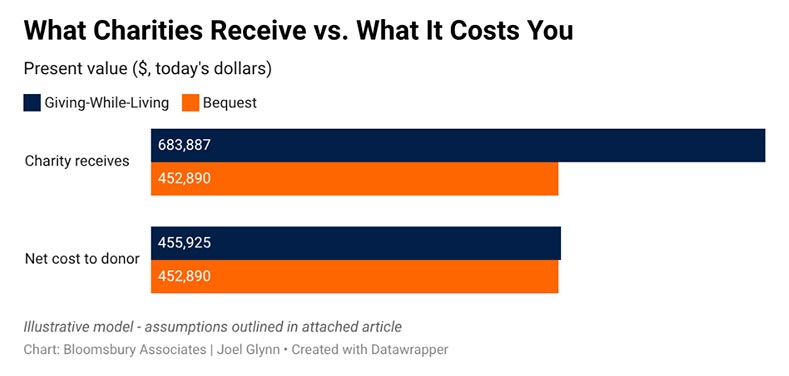
- A $1 million bequest delivered in 40 years is worth $452,890 today.
- $25,000 per year for 40 years has a combined present value of $683,887 today.
That is 51% more real value delivered to charities under the 'giving while living' path. The present-value cost to the donor for giving while living is $455,925, compared with $452,890 for the bequest. The difference is $3,034.
For about $3,034 more in present-value terms, a donor can direct roughly $231,000 more in real purchasing power to the causes they care about.
The tax rebate repeats the advantage every year
The 33.33% charitable donation tax credit is available on donations to IRD–approved organisations. It is claimed annually and refunded directly to the donor - $8,333 per year on a $25,000 donation. Over 40 years, that is $333,320 in nominal tax credits flowing back to the donor in this illustration, that can be redeployed in future giving.
A bequest receives no equivalent here. There is no estate-level deduction for charitable gifts under current New Zealand tax law. Every dollar of a bequest comes from after-tax wealth, with nothing returned in this comparison.
Giving while living captures a meaningful government subsidy, year after year. Deferring entirely to a bequest leaves that benefit unclaimed.
Why timing matters for the organisations
The financial case is straightforward. There is also a practical reason to bring giving forward: organisations need cash flow now to deliver programmes, retain staff, and plan with confidence.
New Zealand's charitable sector is large in number and often thin on reserves. Many organisations operate with modest financial buffers, a small pool of donors, and rising costs. Stable annual giving provides something a distant bequest cannot - certainty that the organisation can plan around. A bequest promised today may arrive too late to pay a staff member through a difficult year, to fund a programme that would otherwise be cut, or to carry an organisation through a period when usual funders step back.
Bequests still matter for many families. The point here is narrower: do not let "later" crowd out "now" if you want the charities you value to thrive and be thriving decades from now.
Consider building a plan to give now
If you are planning a charitable bequest, consider whether part of that intent could become a structured annual giving programme, sized to your financial position and reviewed with your adviser. Done carefully, it captures the tax benefit each year, delivers materially more real value to the causes you support, and helps those organisations stay viable through the years when your support matters most.
The figures in this illustration are striking: giving $25,000 each year over a 40 year period delivers roughly 51% more real impact for charity than a bequest of $1 million.
If you would like to explore what giving while living could look like in your situation - and how it might sit alongside other estate plans - get in touch to explore what this could look like for you.
Note: The scenarios above are illustrative only. They assume $25,000 annual donations over 40 years, a 33.33% New Zealand charitable donation tax rebate applied as modelled, and 2% annual inflation for present-value calculations. Individual circumstances vary - including rebate limits, income timing, and what is prudent for your other goals. Speak to a qualified financial adviser before making giving decisions.